
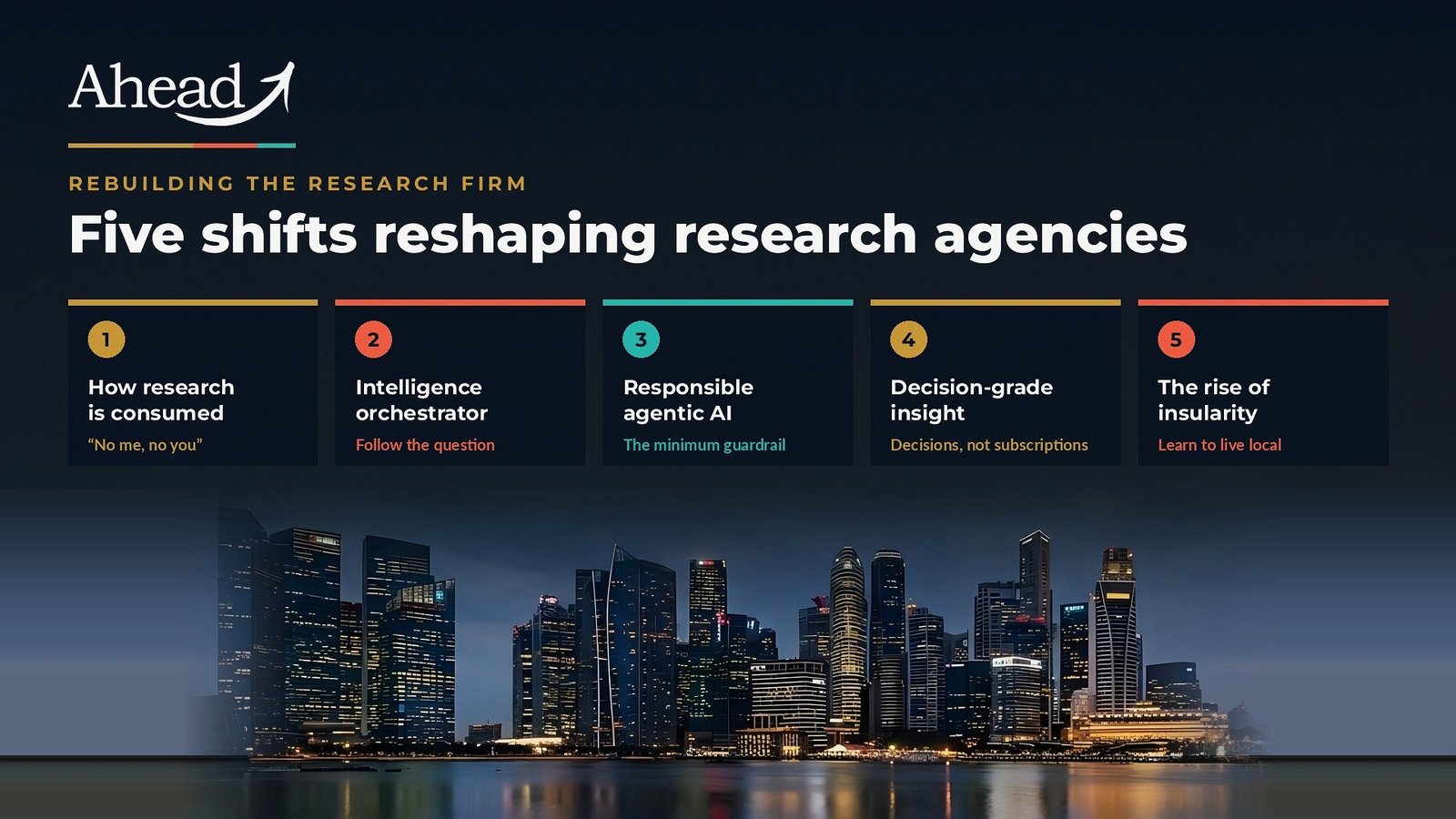
At Futuring Friday APAC last 20th November 2026 for the Festival of NewMR, I shared one slide on how the research firm is being rebuilt. It's not a forecast. Most of these shifts are already showing up in briefs, budgets and procurement conversations across APAC and MENA.
Here are the five shifts, and what I think they mean for us.
1. How research is consumed is changing
Clients aren't waiting for the big annual study anymore. They make fast decisions and iterate constantly, reading market signals as they go.
There's a phrase I keep coming back to: "No me, no you." The old line between research supplier and research buyer is blurring. Buyers now sit closer to data, tools and AI than ever, and many can answer simple questions themselves. There's no "us and them" anymore, only the decision we're both working on.
So we need to understand how the research buyer is evolving: what they decide, how fast, and with whom. And we need to be more relevant than ever, not just more rigorous.
2. The agency becomes an intelligence orchestrator
In the ad industry, people now say creators are the new creative agencies. It's a fair question for us too. Creators, social listening, communities, synthetic research and behavioural data are all producing signals. Will any of them lead the research agency value chain, or will they stay isolated as point solutions?
My view: none of them replaces the agency on its own. Each is a fast but partial signal. The value moves to whoever can orchestrate them: pick the right signal, challenge its bias, add market context and turn it into action.
What we know for sure is that the walls of methodology have already come down. Clients follow the question, not the method. They don't buy a U&A or a conjoint for its own sake. They buy an answer to "where do we grow next?" The agency that leads with the question, and stays open on how to answer it, wins the brief.
3. Responsible agentic AI is the minimum guardrail
Agentic AI is now part of the research stack, with agents that draft questionnaires, code open ends, build tables and write first drafts. The speed is real. So is the risk of outputs that are confident, plausible and wrong.
Responsible agentic AI isn't a differentiator. It's the minimum. Expert humans need to vet the fast signals and bring the structured evidence to life.
I expect new industry standards and ethical guardrails to be set up to establish more professional conduct, building on work like ESOMAR's 20 Questions to Help Buyers of AI-Based Services. That means being clear about where AI was used, how outputs were validated and who made the final call. Buyers will ask. We should be ready before they do.
4. Decision-grade insight is how research will be valued
Buyers will increasingly value and budget research by one test: did it lead to a decision?
If decisions are not made, the project is just a subscription, not a study.
Decision-grade insight is clear enough to act on, grounded enough to defend and specific enough to the market to be trusted. That's where proximity and cultural intelligence come in. In APAC and MENA, the same signal can mean very different things across languages, channels and trust systems. Being close enough to the market to read it properly is what makes insight decision-grade, and what moves agencies from data suppliers to growth partners.
5. The rise of insularity
The last shift sits underneath all the others. Trust is flowing through inner circles and alignments rather than distant playbooks.
This isn't only about the rise of local markets with real buying power. It's also about the decay of global playbooks that follows. And more research budgets are now held by local flagship markets, because the research needs to be closer to the market making the decision.
For global agency players, the lesson is simple and hard: learn to live local. That means local partners, local talent and local relationships.
Researchers are human too
Across all five shifts, one thing is easy to forget. Researchers are human beings, and we need re-skilling too. Prompts, skills and agents are the new tools. Cultural fluency and relationship-building are older skills, and they matter more now.
The good news is neuroplasticity. Our brains keep rewiring as we learn, and researchers are curious by trade. Asking better questions, sitting with ambiguity and spotting what doesn't fit are habits we've built over years. As AI reshapes how everyone works, those curious minds already give us an edge over the general public.
Let's build what's ahead of the research agencies.
Which of these five shifts are you already seeing in your market?
-end-